
Toyota Prius Warning Lights Explained: What They Mean & What You Should Do
A Complete Guide for Toyota Prius Owners
Seeing a warning light on your Toyota Prius dashboard can be unsettling. Whether it's the Check Engine Light, Check Hybrid System warning, or the red Master Warning Triangle, it's natural to wonder if it's safe to keep driving.
The good news is that not every warning light means you should pull over immediately. Some simply remind you that routine maintenance is due, while others indicate your Prius needs professional attention as soon as possible.
In this guide, we'll explain the most common Toyota Prius warning lights, what they typically mean, and when it's time to have your vehicle inspected.
First Things First: What Color Is the Warning Light?
One of the easiest ways to understand the urgency of a warning light is by its color.
🔴 Red Warning Lights
Red warning lights usually indicate a condition that requires immediate attention.
If you notice a red warning light along with unusual noises, poor braking, overheating, or a significant change in how your Prius is driving, pull over safely and consult your owner's manual or have the vehicle inspected before continuing.
Examples include:
- Master Warning Triangle
- Brake Warning Light
- Oil Pressure Warning
- Charging System Warning
🟡 Yellow or Amber Warning Lights
Yellow or amber lights typically mean your Prius has detected a condition that should be inspected soon.
Your vehicle may continue driving normally, but ignoring these warnings could allow a minor issue to become a more expensive repair.
Examples include:
- Check Engine Light
- Check Hybrid System
- ABS Warning
- Tire Pressure Warning
- Traction Control Warning
🟢 Green & Blue Indicator Lights
Green and blue lights usually aren't warning lights at all.
They simply let you know that a feature is currently active.
Examples include:
- READY indicator
- EV Mode
- Cruise Control
- High Beams
The Most Common Toyota Prius Warning Lights
Check Hybrid System Warning
This is one of the most searched warning messages by Prius owners.
The Check Hybrid System warning doesn't automatically mean your hybrid battery has failed. Instead, it tells you the hybrid control system has detected a fault that requires diagnosis.
Possible causes include:
- Hybrid battery issues
- Inverter problems
- Cooling system concerns
- Electrical faults
- Sensor failures
Can you keep driving?
Sometimes—but not always.
Some Prius models may continue operating normally, while others may reduce power or enter a protective mode. If this warning appears, schedule a professional diagnostic inspection as soon as possible.
👉 Related Reading: What Does "Check Hybrid System" Mean on a Toyota Prius?
Check Engine Light
The Check Engine Light can be triggered by something simple, like a loose gas cap, or by an engine or emissions-related problem.
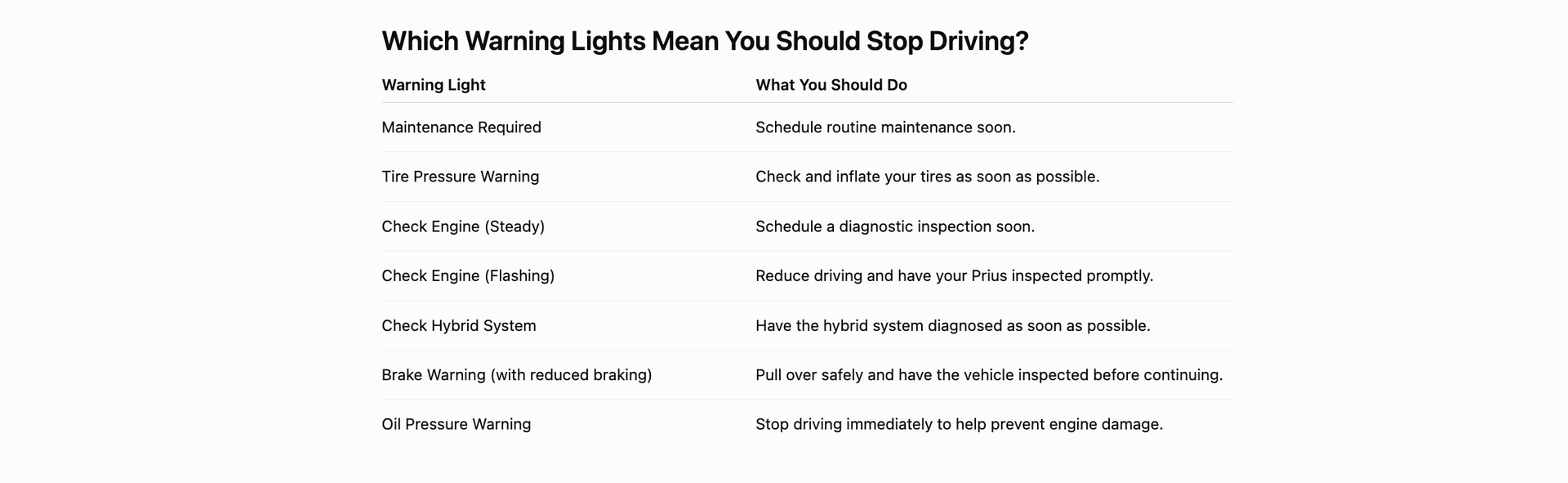
If the light is steady, your Prius can often still be driven while you schedule an inspection.
If the light is flashing, reduce driving and have the vehicle inspected promptly, as it may indicate an engine misfire that can damage the catalytic converter.
Master Warning Triangle
The red triangle with an exclamation point is one of the most misunderstood warning lights on a Toyota Prius.
The triangle itself doesn't identify the problem—it simply tells you another system has detected a condition that needs your attention.
Whenever you see the Master Warning Triangle, check the message displayed on your dashboard for additional information.
Tire Pressure Warning Light
This warning indicates one or more tires may be below the recommended pressure.
Driving with low tire pressure can:
- Reduce fuel economy
- Increase tire wear
- Affect handling
- Increase stopping distance
Before assuming the sensor has failed, check all four tires and inflate them to the recommended pressure.
Brake Warning Light
The Prius uses both conventional brakes and regenerative braking.
If the brake warning light remains on or your braking performance changes, have the system inspected as soon as possible.
Because braking is a critical safety system, it should never be ignored.
12-Volt Battery Warning
Many Prius owners assume this warning refers to the hybrid battery—but that's often not the case.
In many situations, this light indicates a problem with the 12-volt battery or charging system rather than the high-voltage hybrid battery.
A proper diagnostic inspection is the best way to determine the cause.
Maintenance Required Light
This is one of the least serious dashboard indicators.
It usually means your Prius is due for routine maintenance, such as an oil change or tire rotation.
It doesn't necessarily indicate a mechanical problem, but it is a reminder to stay on schedule with preventative maintenance.
👉 Related Reading: Toyota Prius Maintenance Schedule: Complete Guide for Every Mileage
Before You Schedule an Appointment
If a warning light appears, ask yourself these questions:
- Is the warning light red or yellow?
- Is the vehicle driving differently?
- Did the warning appear suddenly?
- Is there a message on the dashboard display?
- Are multiple warning lights on at the same time?
The answers can help determine how urgently your Prius should be inspected.
Why Choose Turnage Auto Care?
Since 2013, Turnage Auto Care has specialized in Toyota, Lexus, and hybrid vehicles. Our experienced technicians use professional diagnostic equipment to identify warning light concerns accurately, helping you avoid unnecessary repairs and get back on the road with confidence.
Schedule a Toyota Prius Diagnostic
A warning light doesn't always mean a major repair—but it should never be ignored.
If your Toyota Prius has a dashboard warning light and you're unsure what it means, the team at Turnage Auto Care can diagnose the issue, explain your options, and recommend the right repair to keep your hybrid performing at its best.